

Yellow Jackets

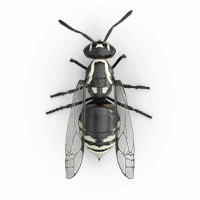
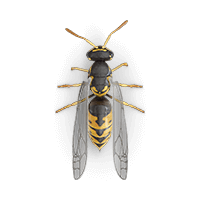
Actual size: up to 0.8 in.
|
|
|
Yellow Jackets at a Glance
Yellow jacket is the name for a particular type of wasp that has black and yellow striped markings. While yellow jackets look similar to bees, they are longer and have thinner bodies.
Another difference between yellow jackets and bees is their sting. Bees sting once and then die. Yellow jackets can sting many times and usually do not die after stinging. Once stung by a yellow jacket, the victim is marked by an odor that excites nearby wasps to also sting the victim. This makes yellow jackets especially troublesome for humans.
But yellow jackets, like all wasps, play a beneficial role in the world. As one of the major scavengers, they eat insects such as flies and caterpillars, which are often considered pests to humans and crops. They also eat fruits and sugars. Some types of wasps even pollinate plants and crops, but most do not. Yellow jackets should be left alone if they are not bothering people.
Life Cycle
The yellow jacket lifecycle has two seasonal peaks: in May the queen emerges to start a colony; in August workers emerge to forage for food.
All yellow jackets are social insects, and they aggressively protect their nests. In early spring, a new nest is started by a single queen who mated the prior fall. The workers expand the nest during the spring and summer.
Yellow jackets are aggressive scavengers, and they are often encountered during cookouts, in trash receptacles and around dumpsters. Many people are stung as they cut tall grass while standing directly over a ground nest.
In the fall, after mating, the males die and the females "overwinter," beginning a new nest the following spring.
The native Eastern yellow jacket builds its nest underground, usually in abandoned rodent burrows. The German yellow jacket builds its nest between walls, in attics and in closed spaces. In both cases, the nests are hard to find.
Allergic Reactions
Some people can have severe-even life-threatening-allergic reactions to wasp stings. Make sure to get immediate medical attention if you experience symptoms other than mild swelling in the area of a sting. Most people suffer only temporary pain when stung, and this pain can be reduced by cooling the affected area with cold water or ice.
Follow These Tips for Effective Yellow Jacket Control:

 |
In the spring, place a trap along the perimeter of your yard to try to catch the queen before the population grows.
 |
 |
When eating outside, bring out the food just before you are ready to eat and clean up right away. This will reduce the chance of attracting yellow jackets.
 |
 |
Restrict wasp access into the home by closing doors and windows-especially when the cool weather arrives. |
 |
Be careful when drinking from open beverage containers. Yellow jackets are highly attracted to the sugar in some beverages and will fly inside containers. |
 |
Make sure that all garbage containers have been sealed and that recycled materials have been rinsed out before being put in the bin. |
 |
Avoid camping or picnicking near garbage bins. |
 |
When camping, store food in sealed containers. |
|